
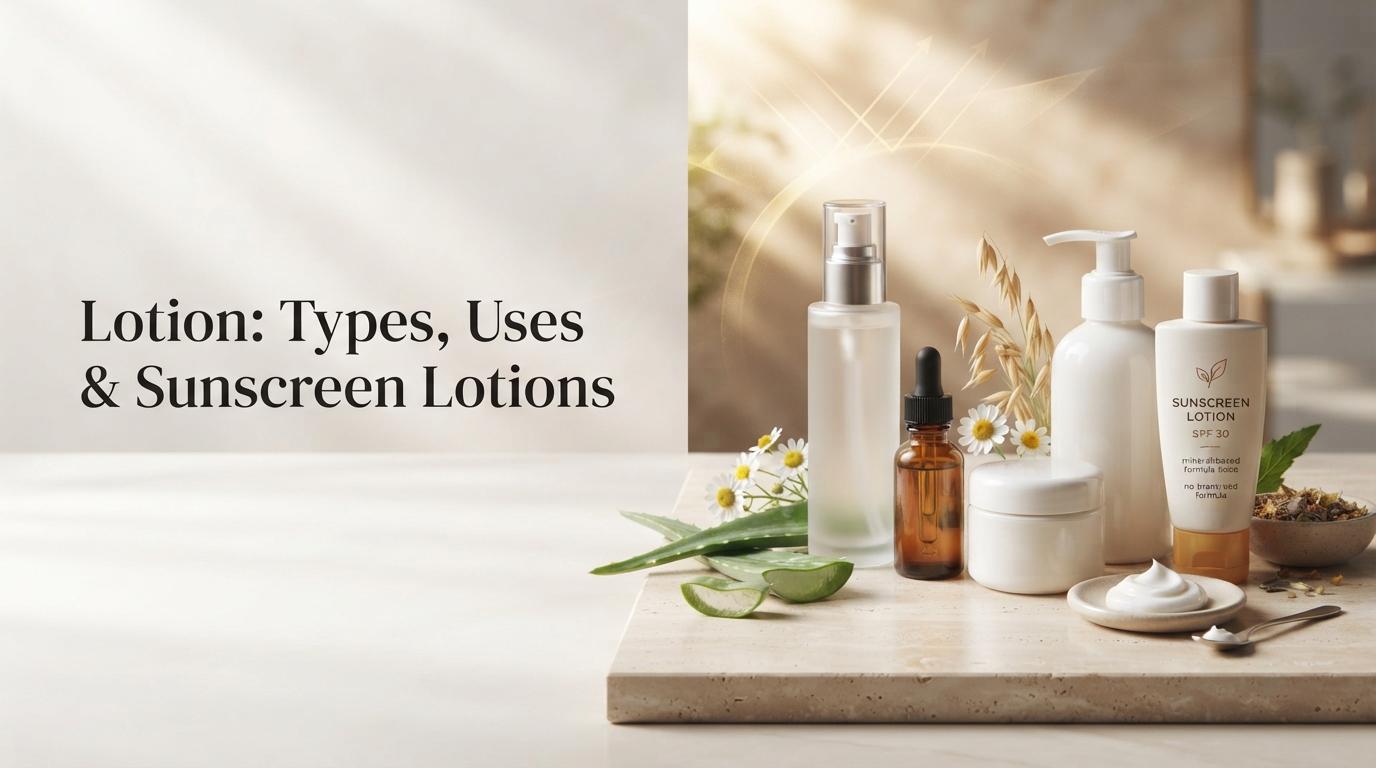
Lotion is a versatile topical preparation found in cosmetic products, everyday moisturizers, pharmaceutical treatments, and sun-protection products. Its relatively fluid consistency makes it easy to distribute across the skin, particularly when larger areas need to be covered.
Although lotions are often associated with body moisturizers, the term covers many different formulations. A lotion can be designed to hydrate dry skin, soften and condition the skin surface, carry a medicinal ingredient, or distribute sunscreen filters across exposed skin.
The ingredients and physical structure of a lotion determine how it behaves. Some formulations contain mostly water, while others combine water with oils, alcohols, suspended particles, or emulsifying systems. The vehicle can also influence how an active ingredient is delivered to the skin.
What Makes a Lotion Different?
A lotion is generally a liquid or semi-liquid preparation intended for topical application. It is usually less viscous than a cream or ointment, allowing it to flow and spread more readily.
The exact boundary between a lotion and other topical formulations is not always strict. Manufacturers can use terms such as lotion, cream, solution, suspension, or emulsion somewhat differently depending on the product. DermNet notes that similar preparations may sometimes be given different names by manufacturers.
One of the practical advantages of a lotion is its ability to cover relatively large areas without requiring the rubbing associated with a very thick preparation.
This characteristic can make lotions useful for the arms, legs, torso, scalp, and other areas where easy distribution is desirable.
The Main Categories of Lotion
Lotions can be grouped according to what they are designed to do.
Everyday Moisturizing Lotions
These products are primarily intended to maintain or improve the skin’s moisture and softness.
They commonly contain combinations of humectants and emollient ingredients, while some also contain substances that reduce water loss from the skin.
Cosmetic Body Lotions
Cosmetic body lotions may focus on moisturizing and improving the feel or appearance of the skin.
They can contain fragrances, botanical ingredients, oils, silicones, emollients, and other cosmetic components.
Therapeutic Lotions
A therapeutic lotion contains an active ingredient intended for a specific dermatological purpose.
Topical medications are available in several formulations, including lotions, creams, gels, and ointments. The most appropriate vehicle can depend on the body site, skin condition, and properties of the active ingredient.
Sunscreen Lotions
Sunscreen lotions are formulated with UV filters and are intended to protect exposed skin from ultraviolet radiation.
They may be designed specifically for sun protection or combined with moisturizing and cosmetic properties.
Suspended-Particle Lotions
Some lotions contain fine insoluble particles dispersed throughout a liquid.
These particles can settle when the product is left standing, which is why certain formulations must be shaken before application.
Ingredients Found in Lotion
The ingredient list varies considerably from one lotion to another. A simple moisturizer and a medicated sunscreen lotion can have very different compositions.
Water
Water is frequently the principal component of lotion formulations.
It provides a liquid phase in which water-soluble ingredients can be incorporated and contributes to the fluid consistency of many products.
Humectants
Humectants attract and retain water.
Glycerin is one commonly used humectant. Other examples include urea and certain hydroxy acids.
These ingredients are often included in moisturizing products because they can increase the water-holding capacity of the outer skin layer.
Emollients
Emollients help soften and smooth the skin.
They can include oils, fatty substances, esters, and other conditioning ingredients. Different emollients can produce very different textures, from lightweight and rapidly spreading to richer and more protective.
Occlusive Ingredients
Occlusives help limit water loss from the skin by forming a barrier over its surface.
Oily and lipid-based ingredients can contribute to this effect. Products with stronger occlusive properties are often more suitable for very dry areas, although some people find richer preparations too greasy.
Emulsifiers
Water and oil do not naturally remain mixed. When both are needed in a formulation, emulsifiers can help create and maintain a stable mixture.
The choice of emulsifying system affects the appearance, consistency, stability, and sensory characteristics of the finished lotion.
Thickeners
Thickeners control the viscosity of a product.
A very thin formulation may behave almost like a solution, while increasing viscosity can produce a more lotion-like consistency.
Preservatives
Many lotions contain water and therefore require protection against microbial contamination.
Preservatives may be incorporated to improve the product’s shelf stability. However, some preservatives can cause contact allergy in susceptible individuals.
Fragrance
Fragrance can be added to create a particular scent or sensory experience.
However, fragrance is not necessary for the moisturizing function of a lotion, and fragrance-free formulations are available.
How Lotion Formulations Work
A lotion can be built using different physical systems.
Solutions
In a solution, the relevant ingredients are dissolved in the liquid vehicle.
This produces a preparation in which the dissolved components are distributed throughout the liquid.
Suspensions
Suspensions contain insoluble particles dispersed through a liquid.
Because gravity can cause these particles to settle, the product may require shaking before application.
Emulsions
Emulsions contain two phases, commonly water and oil, that have been combined using an emulsifying system.
This approach is particularly useful for skin-care products because it allows formulators to combine water-based and oil-based components in a single preparation.
The finished product’s texture depends on the relative amounts and characteristics of its different phases.
Why the Vehicle Matters
The vehicle is not simply a container for the active ingredient. It can influence how the product spreads, feels, remains on the skin, and potentially how an active substance penetrates the skin.
DermNet explains that topical vehicles can be selected according to the application site and the type of skin condition being treated. Factors such as skin thickness, barrier function, occlusion, and the characteristics of the active ingredient can affect absorption.
This is one reason why the same active ingredient can be available in several different topical forms.
A lotion may be selected when easy spreading and relatively low greasiness are desirable, while a cream or ointment may be preferred when a richer or more occlusive preparation is appropriate.
Lotion for Dry Skin
Moisturizing is one of the most common reasons people use lotion.
Dry skin can benefit from products that combine several types of moisturizing ingredients. Humectants help attract water, emollients smooth the skin, and occlusive ingredients can reduce moisture loss.
The ideal texture depends on the severity and location of dryness.
DermNet notes that lotions are commonly used for mild dryness and for areas such as hairy skin, while thicker creams and ointments may be preferred for more pronounced dryness.
Applying moisturizer soon after bathing can also help retain water in the outer layers of the skin.
Lotion for Hairy Areas and the Scalp
The physical consistency of a lotion can make it particularly convenient for areas containing hair.
Thick ointments can be difficult to distribute through hair, whereas a fluid preparation can often be applied more easily.
For this reason, lotions, solutions, gels, and foams are commonly considered for hairy areas such as the scalp.
Pharmaceutical Uses of Lotion
Lotion can serve as the vehicle for a wide variety of topical medications.
Depending on the active ingredient, medicated lotions may be used for conditions involving inflammation, itching, scaling, infection, acne, or other skin problems.
For example, topical acne treatments are available in lotion, gel, cream, and solution forms, with the choice depending partly on the active ingredient and treatment requirements.
The fact that a product is called a lotion does not determine its medical function. The active ingredient, concentration, formulation, and intended use are what determine the treatment.
Lotion vs. Cream
Lotions and creams can both be used for moisturizing and topical treatment, but their physical characteristics differ.
A lotion is generally more fluid and easier to spread across broad areas.
A cream usually has a thicker consistency and can provide a richer skin feel.
For mild dryness or hairy areas, a lotion may be convenient. For more substantial dryness, a cream may provide a more substantial moisturizing effect.
Lotion vs. Ointment
Ointments are generally much more occlusive than lotions.
They often contain a high proportion of oily or greasy components and can remain on the skin for longer.
This makes ointments useful for very dry, thick, or scaly skin, although their greasy feel can make them less desirable for visible or hairy areas.
Lotions, by comparison, are lighter and generally easier to distribute.
The appropriate formulation therefore depends on both the skin condition and the area being treated.
What Is a Sunscreen Lotion?
A sunscreen lotion is a topical lotion containing ingredients that reduce exposure of the skin to ultraviolet radiation.
Sunscreen products can be manufactured in several forms, including lotions, creams, sticks, gels, oils, ointments, sprays, and powders.
A lotion format can be convenient because it can be distributed across relatively large exposed areas.
Some sunscreen lotions are primarily designed for UV protection, while others also contain moisturizing ingredients or cosmetic components.
UVA and UVB Protection
Sunlight contains ultraviolet radiation that can affect the skin.
UVA and UVB represent different portions of the ultraviolet spectrum and contribute to different forms of skin damage.
UVB is strongly associated with sunburn, while UVA contributes to cumulative skin damage and photoaging.
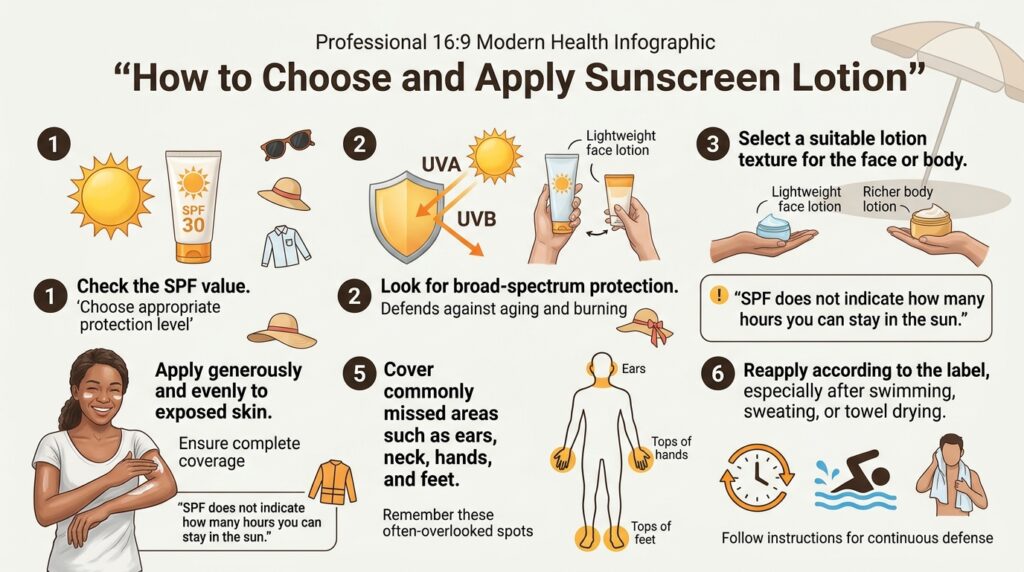
Broad-spectrum sunscreen products are designed to provide protection against both UVA and UVB. In the United States, only sunscreens meeting the FDA’s broad-spectrum requirements can use that designation on their labeling.
Understanding SPF
SPF, or Sun Protection Factor, is a measure used on sunscreen products to describe protection against sunburn under standardized testing conditions.
A higher SPF does not mean that a person can remain in direct sunlight indefinitely.
Sunscreen should be used together with other protective measures, including appropriate clothing and shade.
The FDA currently recommends broad-spectrum sunscreen with an SPF of 15 or higher as part of sun protection and advises applying it liberally to uncovered skin.
How Much Sunscreen Should Be Applied?
The amount of sunscreen used has a direct bearing on the protection obtained.
The FDA states that an average-size adult or child needs at least one ounce of sunscreen to evenly cover the body. It also advises reapplication at least every two hours, with more frequent application after swimming or sweating.
Applying only a very thin layer can provide less protection than expected from the labeled SPF.
For practical use, sunscreen should be spread evenly across all exposed areas rather than concentrating it only on the most visible parts of the body.
Water-Resistant Sunscreen Lotions
Some sunscreen lotions are specifically tested for water resistance.
A water-resistant label does not mean that the product is waterproof. FDA labeling recognizes water-resistance claims for specified periods, such as 40 or 80 minutes, when the product meets the applicable testing requirements.
Swimming, sweating, and towel drying can reduce the amount of sunscreen remaining on the skin.
For this reason, the product’s reapplication instructions should be followed carefully.
Lotion for the Face and Body
Not every lotion is designed for every area of the body.
Facial lotions may be formulated to provide a lighter finish or to work comfortably with other facial products.
Body lotions can be designed for easier application over larger surfaces and may contain richer moisturizing systems.
The same principle applies to sunscreen. A facial sunscreen may prioritize cosmetic appearance, while a body sunscreen may emphasize coverage and ease of application.
Lotion for Sensitive Skin
People with sensitive skin may need to pay particular attention to formulation.
Fragrances, preservatives, active ingredients, and other components can cause irritation or allergic reactions in susceptible people.
DermNet notes that lotions and creams can sometimes cause irritation because of ingredients such as preservatives, solubilisers, and fragrances.
A simpler formulation or fragrance-free product may be preferable for someone who knows that particular ingredients cause problems.
Applying Moisturizing Lotion
Moisturizing lotion is generally easiest to spread when the skin is not excessively dry.
For routine moisturization, applying the product soon after bathing can help retain water in the skin. DermNet recommends applying leave-on moisturizers, including lotions, shortly after bathing when possible.
The amount and frequency required depend on the individual’s skin and the product.
Very dry skin may require more frequent moisturizing than mildly dry skin.
Applying Sunscreen Lotion
Sunscreen should be applied to all exposed skin that needs protection.
Important areas can include:
- Face
- Ears
- Neck
- Arms
- Hands
- Legs
- Feet
- Other exposed areas
The FDA specifically advises covering commonly missed areas such as the nose, ears, neck, hands, feet, and lips.
Sunscreen should be reapplied according to the product’s directions, especially following swimming or heavy sweating.
Can Lotion Cause Side Effects?
Most people can use ordinary lotions without significant problems, but topical products can cause irritation or allergic reactions in some individuals.
Possible symptoms include:
- Burning
- Stinging
- Redness
- Itching
- Swelling
- Rash
People who experience persistent or severe reactions should stop using the suspected product and seek appropriate medical advice.
A reaction does not necessarily mean that every lotion will cause the same problem. Different products contain different ingredients and vehicles.
How to Store Lotion
Storage requirements vary according to the formulation.
Products should generally be kept according to the manufacturer’s instructions and protected from conditions that may damage their stability.
Excessive heat, freezing, direct sunlight, or contamination can affect certain formulations.
Consumers should also pay attention to expiration information and avoid assuming that an old or visibly altered product will perform in the same way as a fresh product.
Choosing the Right Lotion
Rather than choosing a lotion solely because of its marketing claims, consider the actual purpose of the product.
Useful factors include:
- Skin type
- Degree of dryness
- Area of application
- Desired texture
- Moisturizing ingredients
- Active ingredients
- Fragrance preferences
- Known sensitivities
- Whether UV protection is required
- SPF
- Broad-spectrum protection
- Water resistance
- Application instructions
For everyday skin care, texture and moisturizing properties may be the main considerations.
For outdoor use, the sunscreen’s SPF, broad-spectrum status, application instructions, and water-resistance information become particularly important.
Frequently Asked Questions
Is lotion considered a moisturizer?
A lotion can be a moisturizer, but the two terms do not mean exactly the same thing. Lotion describes a type of topical preparation, while moisturizer describes a product intended to improve skin hydration or reduce dryness.
Why do some lotions need to be shaken?
Some lotions contain suspended particles that settle during storage. Shaking redistributes those particles throughout the liquid before application.
Are lotions good for dry skin?
Many lotions are suitable for mild dry skin. More severe dryness may sometimes respond better to richer creams or ointments.
Can lotion be used on the scalp?
Some lotions are suitable for hairy areas and the scalp because their fluid consistency makes them easier to distribute than thick ointments.
Is sunscreen lotion different from ordinary lotion?
Yes. Sunscreen lotion contains UV-filtering ingredients and is specifically intended to provide sun protection. A normal moisturizing lotion should not be assumed to provide sunscreen protection.
Does SPF tell you how long sunscreen lasts?
No. SPF is not a number of hours that sunscreen remains effective. Sunscreen needs to be reapplied according to its directions.
Does water-resistant sunscreen remain on after swimming?
Not indefinitely. Water-resistant products are tested for specified periods, and sunscreen should be reapplied according to the label after swimming or sweating.
Can a lotion contain medicine?
Yes. Lotions can serve as vehicles for pharmaceutical active ingredients used in topical treatments.
Conclusion
Lotion is a flexible topical format capable of serving many different purposes. Its relatively fluid consistency makes it useful for spreading products over large or hairy areas, while its formulation can be adjusted to deliver moisturizing ingredients, cosmetic components, pharmaceutical actives, or sunscreen filters.
The composition of a lotion determines much of its performance. Humectants can help attract water, emollients soften the skin, occlusive ingredients reduce water loss, and emulsifiers help combine otherwise incompatible phases.
Sunscreen lotions add UV protection to this versatile format. When selecting one, consumers should pay attention to SPF, broad-spectrum labeling, water-resistance information, application instructions, and the need for reapplication.
For moisturizing, pharmaceutical treatment, or sun protection, there is no single formulation that is appropriate for everyone. The most suitable lotion depends on the purpose, application area, skin characteristics, and ingredients contained in the individual product.
References
- DermNet. Topical formulations. Information on lotions, solutions, suspensions, creams, ointments, vehicles, and topical formulation principles.
- DermNet. Emollients and moisturisers. Information on lotions, creams, ointments, humectants, emollients, preservatives, and moisturizing use.
- DermNet. Topical medications for skin conditions. Information on topical medicines and different formulations.
- U.S. Food and Drug Administration. Tips to Stay Safe in the Sun: From Sunscreen to Sunglasses. Information on SPF, broad-spectrum sunscreen, application, reapplication, and water resistance.
- U.S. Food and Drug Administration. Labeling and Effectiveness Testing: Sunscreen Drug Products for Over-the-Counter Human Use. Information on broad-spectrum and water-resistance testing and labeling.